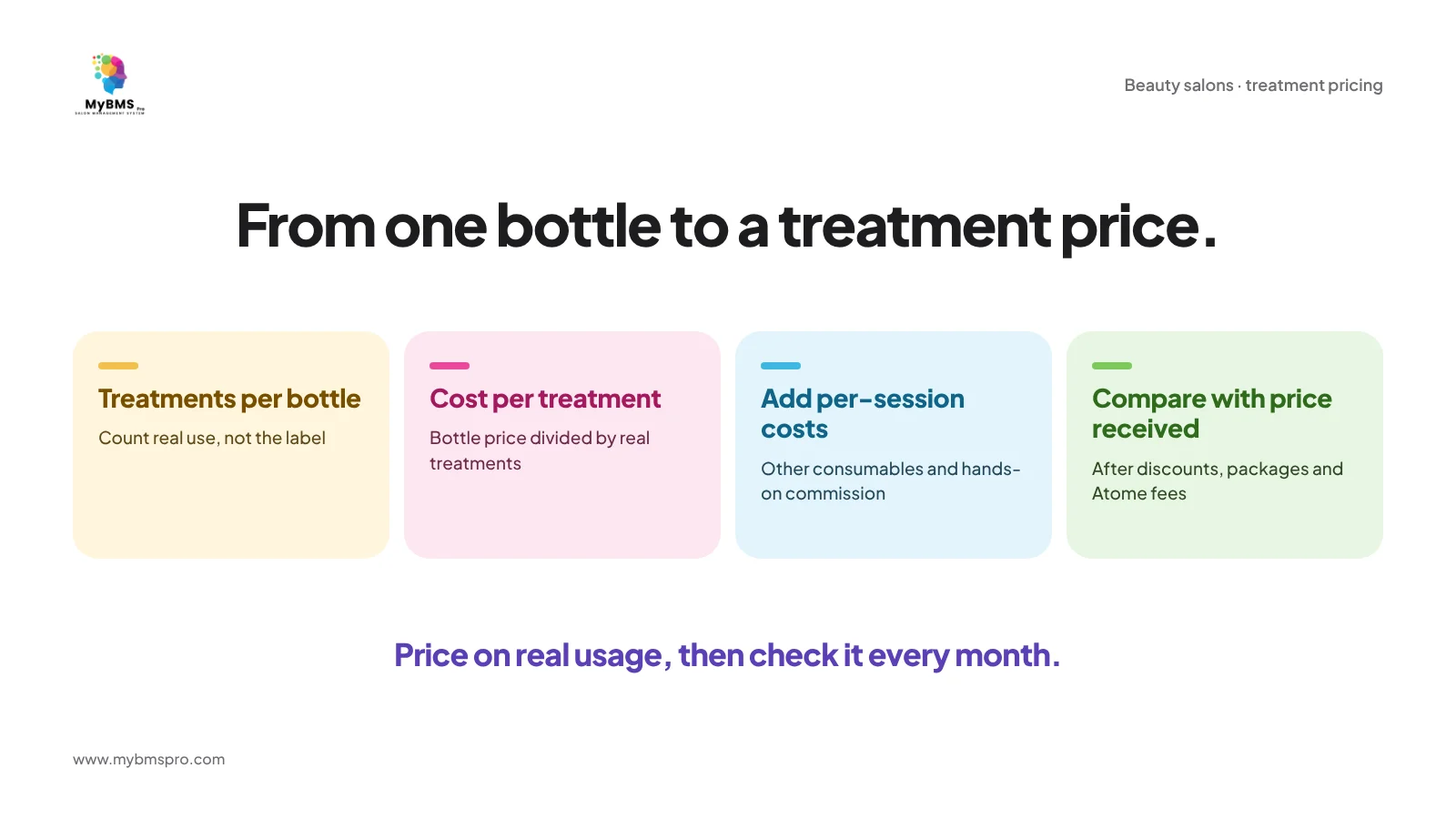
To price a salon treatment properly, first find out how many treatments one professional-size bottle really covers in your salon, not what the label or supplier says. Divide the bottle’s cost by that real number to get the product cost per treatment, add the other consumables and the therapist’s hands-on commission, and compare the total with what the customer actually pays per session. In MyBMS Pro, each treatment’s bill of materials (BOM) is deducted from stock when the session is done, so your stocktake shows whether real usage matches the usage you priced on.
Why consumable cost slips out of treatment prices
Most salons set treatment prices by looking at the market: what nearby salons charge, what customers will accept, what the last promotion was. The cost of the serum, ampoule or mask used in the room is often a rough guess, or left out completely.
That guess goes wrong in a few common ways:
- Trusting the label. A bottle may say how many applications it gives, but your therapists’ real usage depends on the treatment, the customer and the habit of each therapist.
- Forgetting the small items. Masks, cotton, gauze and disposable items look cheap one by one, but they are used in every single session.
- Pricing the single session, then selling packages. The package price per session is usually lower than the single price, so the margin per session is thinner than it looks.
- Never checking again. Supplier prices change and new products replace old ones, but the treatment price stays the same for years.
I always tell owners to price a treatment only after they know what one session really uses. A price that feels right on paper can quietly lose money if the consumables were never counted.
William Tang, Founder, MyBMS Pro
Step 1: Find out how many treatments one bottle really covers
Ask your senior therapists to agree on a normal amount for each treatment, and write it down. Then test it: open a new bottle, note the date, and count how many treatments it actually covers before it runs out. If the real number is lower than the label suggests, plan with the real number.
Do this for the main products in your most popular treatments first. You do not need to measure every item on the shelf on day one.
Step 2: Turn the bottle cost into a cost per treatment
Divide the price you paid for the bottle by the number of treatments it really covers. That is the product cost of one treatment for that serum.
Repeat it for every product the treatment uses, then add the disposable items. The total is the consumable cost of one session. For example, if a facial uses a serum, an ampoule and a sheet mask, all three belong in the cost, not just the most expensive one.
Step 3: Add the hands-on commission for each session
Consumables are not the only cost that comes with every session. The therapist who does the treatment usually earns a hands-on commission for it. Add it to the cost per session, because it is paid every time the treatment is done, whether the customer paid for a single session or a package.
Step 4: Compare the cost with what you actually receive per session
Now look at the price side. For a single session, use the price the customer actually pays after any discount. For a package, divide the package price the customer actually paid by the number of sessions. If the customer paid with Atome, use the amount the salon receives after the platform’s fee.
What is left after the cost per session is the margin that has to cover rent, wages and everything else. If a popular package leaves very little, you have three choices: change the price, change the product or the amount used, or change the package. Read more on why sales commission should follow money collected.
Step 5: Check real usage against your plan every month
A price built on consumable cost is only as good as the usage behind it. Compare the stock you actually have with the stock you should have after the treatments done this month. If more product is disappearing than the treatments explain, either the usage per treatment is higher than planned, or product is being wasted. Either way, your cost per treatment is higher than the price assumes.
Our guide to BOM stock deduction for salon consumables explains how to set this up. For hair salons, see colour cost and pricing.
How MyBMS Pro helps you keep consumable cost visible
MyBMS Pro is an AI-driven, next-generation SaaS management hub specifically designed for multi-branch beauty salons. It does not set your prices, but it keeps the numbers behind them honest:

- BOM double deduction. Each treatment has a bill of materials. When a bill is closed or a package session is redeemed, the session and the in-salon consumables are deducted together.
- Branch stocktake. Each branch can run its own stocktake, and HQ sees stock across all branches, so you can compare real stock with what the treatments should have used.
- Package tracking. Remaining sessions, history and outstanding balances for every package, so you know how many sessions you still owe at the package price.
- Two-track commission. Hands-on commission is counted when a session is redeemed, and sales commission is based on money actually collected, including Atome after the platform fee.
MyBMS Pro is a web-based system used in the browser. See the beauty salon solution for more. If you are deciding on a new machine treatment, read what to check before buying a beauty machine.
FAQ
How do I know how many treatments one bottle of serum covers?
Agree on a normal amount per treatment with your senior therapists, then count how many treatments a new bottle actually covers before it runs out. Plan with that real number, not the label.
How do I calculate the product cost of one facial treatment?
Divide each bottle’s price by the number of treatments it really covers, add up every product the treatment uses, then add the disposable items.
Should hands-on commission be included in the cost of a treatment?
Yes. It is paid every time the treatment is done, so it belongs in the cost per session together with consumables.
Why does my treatment look profitable but the month-end numbers do not?
Common reasons are packages sold at a lower price per session, consumables used more than planned, and small disposable items left out of the cost. Compare real stock with expected usage to find out.
Is there a MyBMS Pro mobile app?
No. MyBMS Pro is a web-based system used in the browser.
See what every treatment really uses
Want to see BOM deduction and package tracking for your salon? Book a free demo of MyBMS Pro and bring the treatment list you want to check.
See how MyBMS Pro runs bookings, POS, memberships and staff commission in one system — built for salons, spas, clinics and car grooming businesses in Malaysia.
Written by
William Tang · Founder & CEO, BMS Solution Sdn. Bhd.
William Tang is the founder of BMS Solution Sdn. Bhd., the Malaysian company behind MyBMS Pro. He works hands-on with salons, spas, clinics and car-grooming businesses across Malaysia, helping them move bookings, POS, memberships and staff management onto one cloud platform.