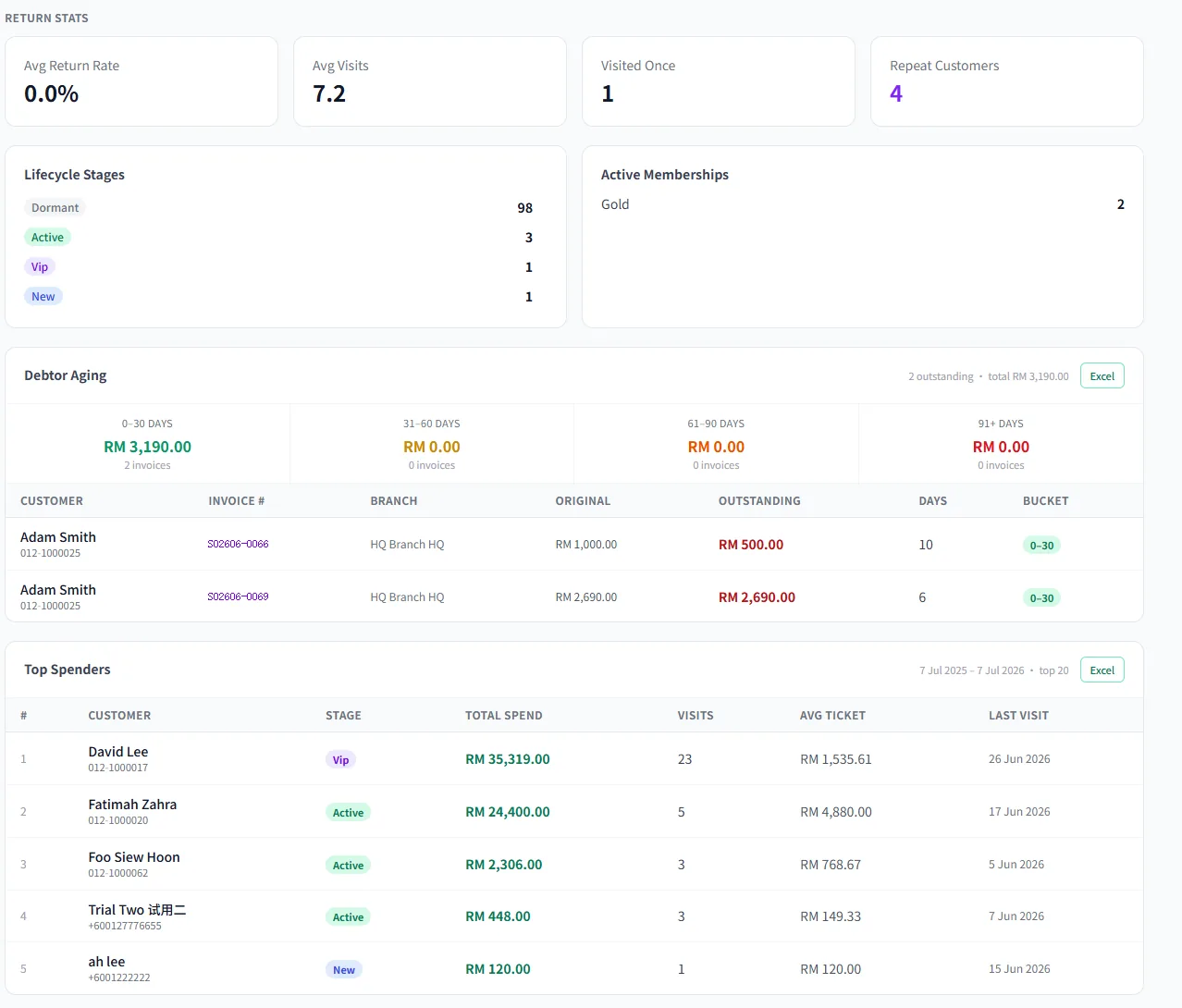
Most salon owners know their monthly revenue and almost nothing else — which is like driving with only a fuel gauge. The businesses that grow track a handful of key performance indicators (KPIs) that reveal what revenue alone hides: whether customers come back, whether staff are productive, and where money is leaking. This guide lists the twelve salon KPIs that matter most in 2026, with realistic benchmarks, so you know not just your numbers but whether they're good.
Key takeaways
- ✓Revenue alone hides the truth — track retention, productivity and mix too.
- ✓Rebooking rate is arguably the single most predictive KPI of salon health.
- ✓Aim for chair/staff utilisation of 70–85% and a no-show rate under 10%.
- ✓A healthy retail-to-service ratio is often around 10–20%.
- ✓KPIs are only useful if they're live — software turns every booking and sale into a dashboard automatically.
Why tracking salon KPIs matters
A KPI is a number that tells you whether the business is winning or losing at something specific. Tracked monthly, KPIs turn vague feelings (“it feels busy”) into decisions (“utilisation is 60%, so we push mid-week bookings”). You don't need dozens — you need the right handful, reviewed consistently.
The 12 salon KPIs that matter (with benchmarks)
- 1Average ticket — total revenue ÷ number of visits. Rising over time is the goal; benchmark against your own trend.
- 2Rebooking rate — % of clients who book their next visit before leaving. A strong salon hits 30–50%+.
- 3Client retention rate — % of clients who return within a set period. Aim for more than half of your clients being repeat.
- 4New clients per month — the top of your funnel; track the trend and where they come from.
- 5Retail-to-service ratio — retail revenue as a % of service revenue. Around 10–20% is healthy for most salons.
- 6Chair / staff utilisation — % of available working hours actually booked. 70–85% is a productive, sustainable range.
- 7Average revenue per staff — output per stylist; helps with rostering and commission design.
- 8No-show rate — % of appointments missed without notice. Keep it under 10%, ideally under 5%.
- 9Service vs product revenue mix — the balance of skill-based versus retail income.
- 10Customer lifetime value (CLV) — total a client spends over their relationship with you. The number that justifies retention effort.
- 11Membership / package penetration — % of clients on a package or membership. Higher means more locked-in revenue.
- 12Revenue per outlet / per available hour — normalises performance across branches and time.
The four to watch every single month
If you only track four, make them these — they catch most problems early:
- ✓Rebooking rate — the earliest warning of a retention problem.
- ✓Utilisation — tells you whether to fill gaps or hire.
- ✓No-show rate — a direct hit to revenue you can fix with WhatsApp reminders.
- ✓Average ticket — shows whether upsell, retail and packages are working.
Turning KPIs into action
A KPI is only worth tracking if it changes what you do. Low rebooking? Train staff to book the next visit at checkout. Low utilisation mid-week? Run a targeted WhatsApp offer for those slots. High no-shows? Turn on deposit requests and reminders. Low retail ratio? Give staff a retail commission and a simple recommendation script.
How to track salon KPIs without spreadsheets
Calculating these by hand from receipts is slow and error-prone, so most owners simply don't. The alternative is a system that produces them automatically from data you're already capturing:
- ✓Every booking and sale feeds revenue, utilisation and no-show numbers.
- ✓The CRM tracks new vs returning clients and rebooking automatically.
- ✓Reports show per-staff and per-branch performance without manual tallying.
MyBMS Pro turns every booking and POS sale into live dashboards — revenue, staff performance, retention and more — so you see your true numbers without touching a spreadsheet.
Stop guessing whether your salon is healthy. MyBMS Pro turns every booking and sale into live KPIs — retention, utilisation, staff and branch performance — so you make decisions on numbers, not gut feel.
Written by
William Tang · Founder, BMS Solution Sdn. Bhd.
William Tang is the founder of BMS Solution Sdn. Bhd., the Malaysian company behind MyBMS Pro. He works hands-on with salons, spas, clinics and car-grooming businesses across Malaysia, helping them move bookings, POS, memberships and staff management onto one cloud platform.