There is no fixed number of months: how long an aesthetic clinic’s laser or other energy-based device takes to pay back depends on how many sessions it actually performs, what each session really earns after consumables, and how much of the machine’s value each session uses up. The reliable way to know is to track payback progress for each device, counting sessions when they are performed or redeemed, not when a course is sold.
Why payback is harder to see in an aesthetic clinic
Aesthetic clinics often invest in high-value laser and energy-based devices, and several things make it easy to misjudge how a device is doing:
- Courses are paid upfront. A patient pays for a full course on day one. If that money is counted as the machine’s income straight away, the device looks as if it has paid for itself before most sessions have been done.
- Each device has its own costs. Tips, cartridges, gels and other consumables differ from one device to another, so one clinic-wide margin hides which machine is doing well.
- Utilisation varies week to week. A device can be fully booked during a promotion and then sit idle for days.
- Patients move between branches. In a clinic group, a patient may buy a course at one branch and continue at another, so a branch-by-branch spreadsheet loses part of the picture.
- Patients stop coming. Sessions that are paid for but not yet done are still owed to the patient, so they are a liability, not earned income.
Many owners count the money from course sales as the machine’s income, so they believe the machine paid for itself long ago. I recommend counting each session actually performed, minus consumables and depreciation per use. Only then do you see the real payback progress.
William Tang, Founder, MyBMS Pro
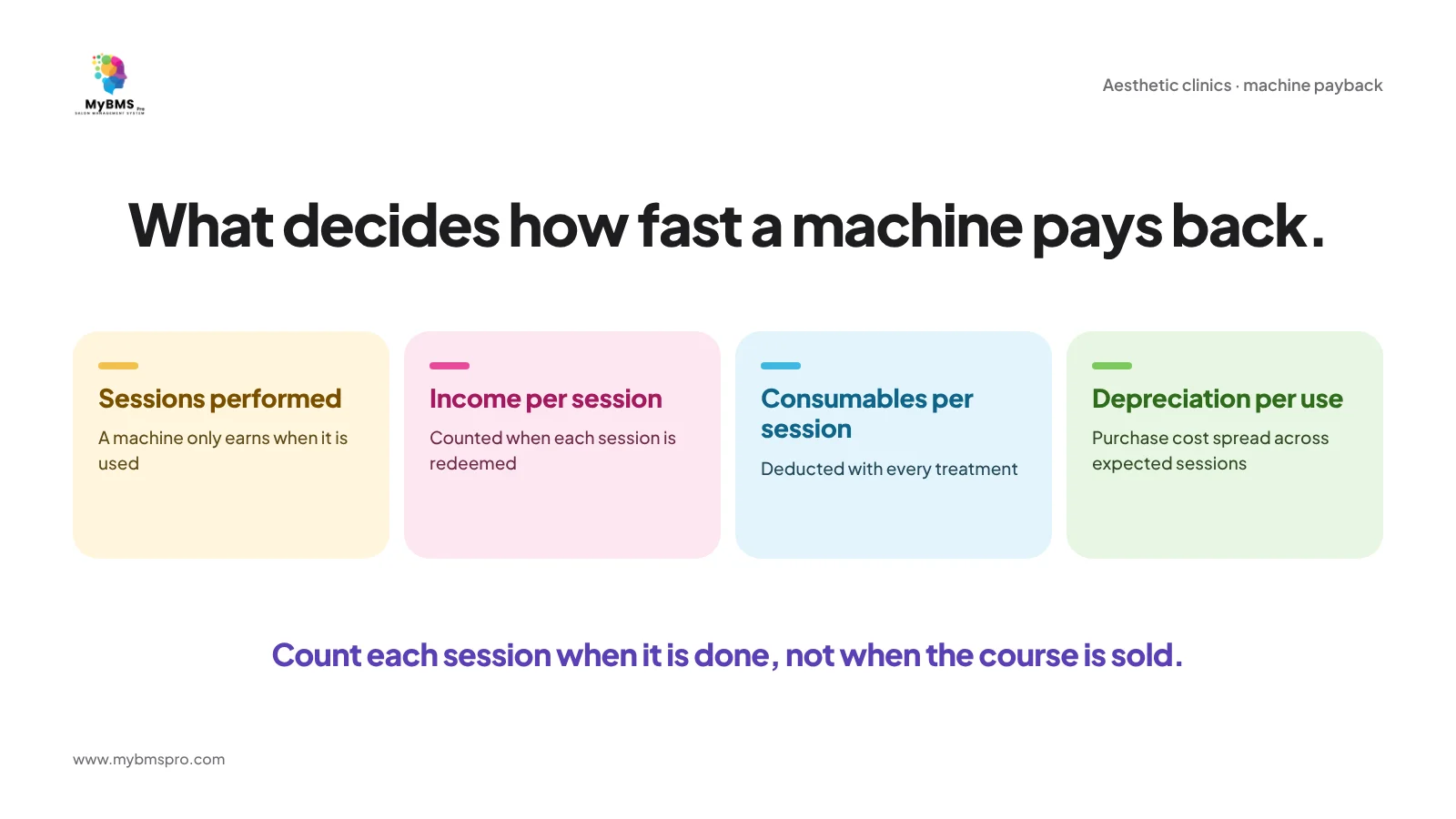
What decides how fast a device pays back
Four things together decide how quickly a machine earns back its cost:
- Sessions actually performed. A device only earns when it is used. Sessions redeemed from a course count when they are done.
- What each session really brings in. For a course, use the value of each session at redemption, not the full course price on the day of sale.
- Consumables per session. What each treatment uses up, deducted session by session. See how to work this out in aesthetic clinic cost per treatment.
- Depreciation per use. The machine’s purchase cost spread across the sessions you expect it to perform over its working life.
Revenue per session, minus consumables, minus depreciation per use, gives the true margin of each session. Added up over time, that margin is the machine’s payback progress. The step-by-step formulas are in our guide to beauty machine ROI.
Signs a device is paying back slower than you think
- Payback progress has stalled while the device still appears busy on the booking calendar.
- Many sessions are sold but not redeemed. Course sales look strong, but the work, and therefore the earned income, has not happened yet.
- Consumable use is higher than the treatment’s standard, so the true margin of every session is lower than planned.
- Course patients have gone quiet. Patients who have not visited for 90 days are not completing their courses, so the device is not performing the sessions it was bought for.
- Cross-branch sessions are missing from the numbers, so one branch’s device looks weaker than it really is.
Before you buy the next device
Payback data turns a purchase decision into a clearer question:
- Has the current device reached a healthy point in its payback? If not, find out why before adding another.
- Is the slowdown caused by low demand or by unfinished courses? The fix for each is different: marketing for the first, follow-up for the second.
- Can patients be scheduled better? Planning each next session at the treatment’s standard interval, with WhatsApp reminders, keeps courses moving. See aesthetic clinic follow-up scheduling.
- Is the true margin per session known for each device? Compare machines on margin per session, not on how many courses they helped to sell.
How MyBMS Pro tracks machine payback
MyBMS Pro is an AI-driven, next-generation SaaS management hub specifically designed for multi-branch beauty salons. For aesthetic clinics, these features work together on machine payback:
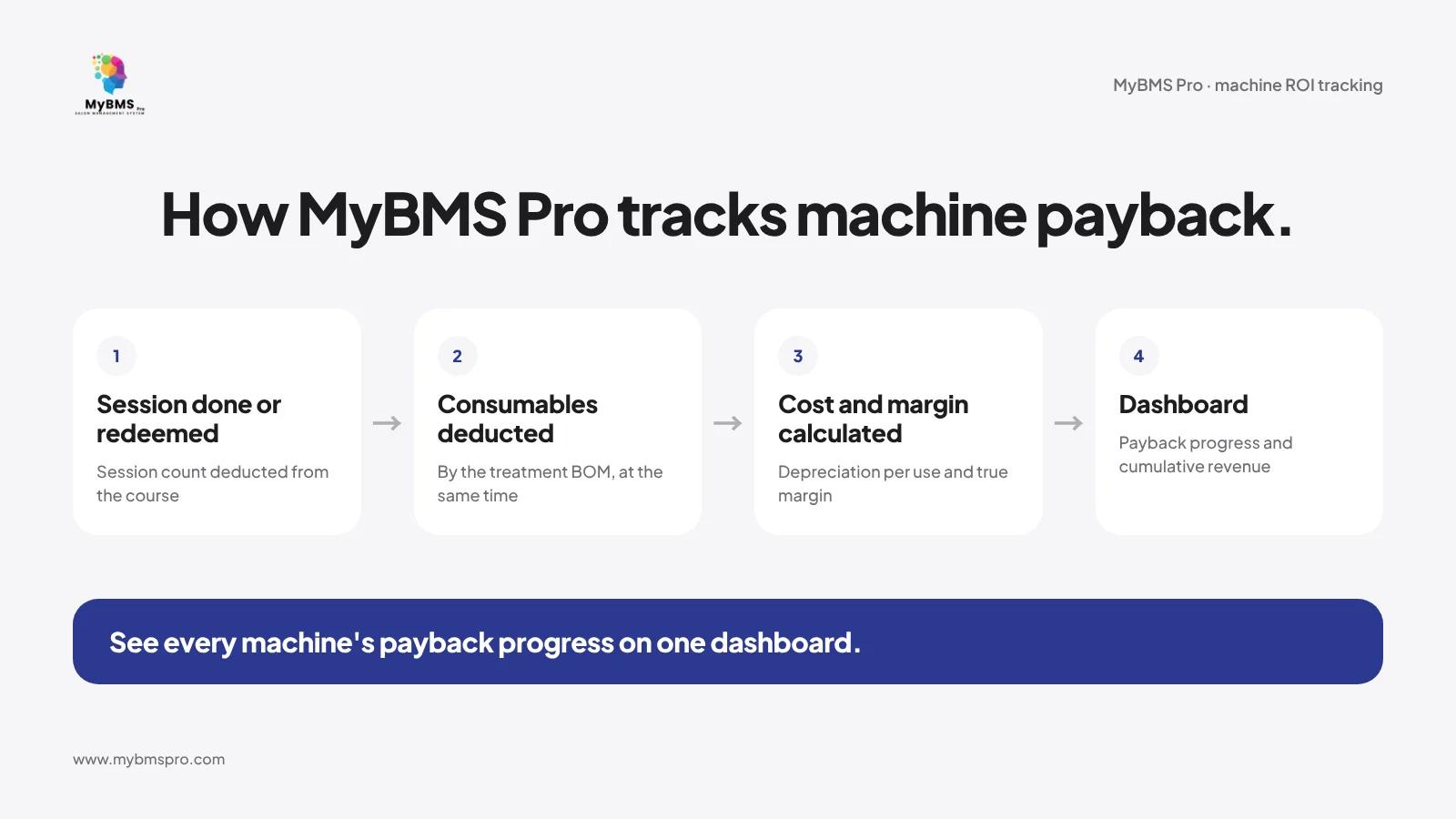
- Machine ROI tracking. Calculates the depreciation cost of each use and the true margin of every session, and the dashboard shows each machine’s payback progress and cumulative revenue.
- Treatment BOM with double deduction. When a bill is closed or a course session is redeemed, the session count and the clinic-use consumables are deducted at the same time.
- Course and package tracking. Remaining sessions, history and outstanding balance for every patient, redeemed at the same branch or another branch.
- Cross-branch redemption. A course bought at Branch A can be performed at Branch B, with commission routed automatically and a cross-branch settlement report.
- Automatic interval scheduling and WhatsApp reminders. The next session is planned at the standard treatment interval and the reminder is sent by WhatsApp.
- AI dormant customer alert. Patients who have not visited for more than 90 days are flagged, so unfinished courses can be followed up.
- AI business dashboard. Daily patient flow, revenue trend, target achievement and outstanding balances in one view.
MyBMS Pro is a web-based system used in the browser. See more on our aesthetic clinic solutions page, or read what a multi-branch aesthetic clinic needs from its software.
FAQ
How long does an aesthetic laser machine take to pay back?
It depends on how many sessions the machine performs, the real income of each session after consumables, and its depreciation per use. Track payback progress for each machine instead of relying on a fixed estimate.
How do I calculate depreciation per use for a clinic device?
Divide the purchase cost of the machine by the number of sessions you expect it to perform over its working life. Each session uses up that share of the machine’s value.
Should course sales count towards a machine’s payback?
Count each session when it is performed or redeemed, not when the course is sold. Unredeemed sessions are still owed to the patient.
Can MyBMS Pro show payback progress for each machine?
Yes. Machine ROI tracking calculates depreciation per use and true margin per session, and the dashboard shows payback progress and cumulative revenue for each machine.
Is there a MyBMS Pro mobile app?
No. MyBMS Pro is a web-based system used in the browser. You can book a free demo to see machine ROI tracking with your own devices in mind.
Want to know which of your clinic’s machines are really paying back? Book a free demo of MyBMS Pro and see machine ROI tracking, treatment BOM and course tracking working together.
See how MyBMS Pro runs bookings, POS, memberships and staff commission in one system — built for salons, spas, clinics and car grooming businesses in Malaysia.
Written by
William Tang · Founder & CEO, BMS Solution Sdn. Bhd.
William Tang is the founder of BMS Solution Sdn. Bhd., the Malaysian company behind MyBMS Pro. He works hands-on with salons, spas, clinics and car-grooming businesses across Malaysia, helping them move bookings, POS, memberships and staff management onto one cloud platform.