To know what one treatment really costs an aesthetic clinic, add up three things for every session: the consumables it uses (listed in the treatment’s bill of materials), the share of the machine’s cost used up by that session (its depreciation per use), and the hands-on commission paid to the practitioner who performs it. Subtract those from the amount the clinic actually received for the session and you have the true margin. MyBMS Pro links each treatment to its consumables and its machine, so stock is deducted automatically and the real margin of every machine treatment is visible, not guessed.
Why many clinics do not know their real cost per treatment
Most aesthetic clinics know the price of every treatment on their menu. Far fewer know what each session costs to deliver. The usual reasons:
- The price is set, the cost is guessed. Treatment prices are often based on the market, while the cost side is an estimate made once and never checked again.
- Packages are paid upfront, costs arrive later. A course is paid for on day one, but the consumables, machine time and practitioner’s commission are spent session by session, sometimes over many months.
- Usage differs between practitioners. Without a standard quantity per treatment, two practitioners can use very different amounts of the same gel or serum.
- Machine cost is never split per use. An expensive machine is recorded as one big purchase, so no single treatment carries its share of that cost.
- Instalment fees reduce what you receive. When a patient pays through a buy now, pay later platform such as Atome, the amount that reaches the clinic is lower than the treatment price.
When any of these is missing, a treatment can look profitable on the sales report while earning very little per session.
One clinic only discovered from its reports that its most popular anti-ageing machine treatment was almost loss-making once the original probe cost and the doctor’s commission were deducted. They stopped selling it cheaply on its own and turned it into a package bundled with high-margin skincare treatments.
William Tang, Founder, MyBMS Pro
The four parts of cost per treatment
1. Consumables, from the treatment BOM
A treatment bill of materials (BOM) is the recipe for a service: the consumables one session should use, such as gel, serum, a mask or a disposable probe, and the standard quantity of each. Once it is set, you know what a session should use instead of relying on each practitioner’s habit.
2. Machine cost per use
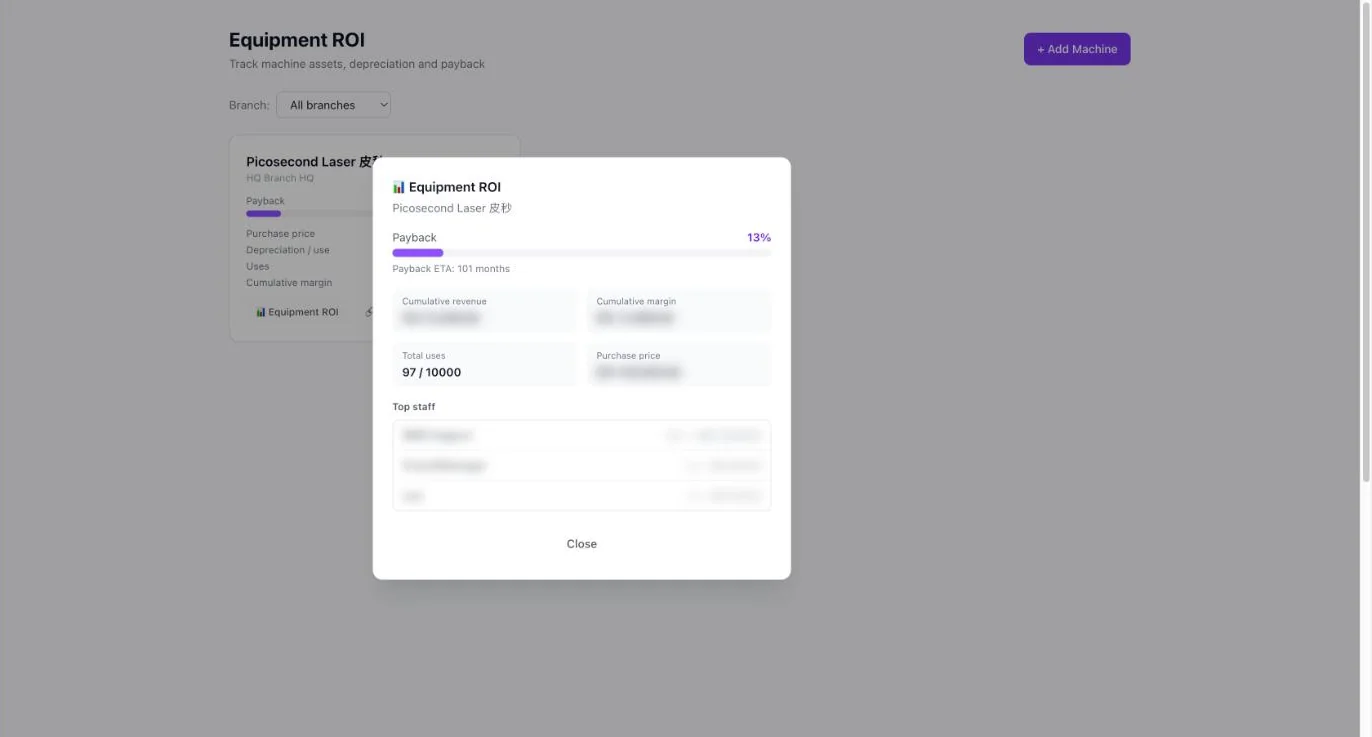
If the treatment uses a machine, each session uses up part of that machine’s value. Treating the machine as a fixed asset and calculating its depreciation cost per use gives every machine treatment its fair share of the purchase. We explain this in more detail in our guide to beauty machine ROI.
3. Hands-on commission
The practitioner who performs the session earns a hands-on commission when the package session is redeemed or the service is consumed. It is a real cost of delivering that treatment, separate from the sales commission paid to whoever sold the course.
4. What the clinic actually received
Start from the amount that actually reached the clinic, not the menu price. For instalment payments, that means the amount received after the platform’s fee.
Put together: true margin per session = amount actually received − consumables − machine cost per use − hands-on commission. Fixed overheads such as rent and salaries are better tracked separately, so the per-treatment figure stays easy to compare between treatments.

An example across two branches
Take a patient who buys a course of skin treatments at Branch A, then comes back for one session at Branch B:
- The session is redeemed at Branch B. The remaining sessions on the patient’s package are updated at the same moment.
- Consumables are deducted from Branch B’s stock according to the treatment’s BOM, so the branch that used them carries the cost.
- The session counts toward the machine’s payback at Branch B, using its per-use depreciation cost.
- The Branch B practitioner earns the hands-on commission, while the sales commission stays with the Branch A staff member who sold the course, based on the amount actually collected.
- At month end, the cross-branch settlement report shows how the session was split between the two branches.
Every branch then sees the true cost of the work it actually did, which is what makes branch-by-branch margins fair to compare.
How to set it up in your clinic
You do not need to cost every treatment on day one. A practical order:
- Start with your machine treatments and your most consumable-heavy treatments. That is where cost per session matters most.
- Agree the standard usage with your senior doctors or practitioners, according to your clinic’s own protocol.
- Link each consumable to the treatment with its standard quantity.
- Register each machine as a fixed asset so its cost per use can be calculated.
- Check your commission rules so hands-on commission is triggered when sessions are redeemed.
What to review every month
- Expected versus actual stock. At stocktake, compare what the BOM says should have been used with what is left on the shelf. A large gap points to waste, missing items or a BOM that needs updating.
- Machine payback progress. See how close each machine is to paying for itself and how much revenue it has brought in so far.
- Treatments with thin margins. If a popular treatment earns little per session, review its price, its BOM or how it is bundled into packages.
- Unused package sessions. Sessions already paid for but not yet delivered still carry their consumable and commission cost in the future.
How MyBMS Pro helps you see the real cost
MyBMS Pro is an AI-driven, next-generation SaaS management hub specifically designed for multi-branch beauty salons. For aesthetic clinics, it brings the cost side of every treatment into one place:

- Treatment BOM & Stock Module. When a treatment is completed or a package session is redeemed, the session count and the consumables in its BOM are deducted at the same time.
- Machine ROI Calculator. Each machine is treated as a fixed asset, with its depreciation cost per use and true margin calculated. The AI dashboard shows a payback progress bar and cumulative revenue.
- Dual-track tiered commission. Sales commission is calculated on total collection; hands-on commission is triggered when a package session is redeemed or a service is consumed.
- Instalment payment support. For payments through platforms such as Atome, the amount actually received after the platform’s fee is recorded and used as the basis for sales commission.
- Inventory across branches. HQ can see every branch’s stock and dispatch supplies, branches can request replenishment for HQ approval, and each branch keeps its own stocktake.
See how this fits a clinic setup on our aesthetic clinic solution page, or read our wider aesthetic clinic operations guide.
FAQ
How do I calculate the cost of one aesthetic treatment?
Add the consumables used in the session, the machine’s depreciation cost for that use and the hands-on commission paid to the practitioner. Subtract the total from the amount the clinic actually received for the session to get the true margin.
Should rent and staff salaries be included in cost per treatment?
It is usually clearer to keep fixed overheads such as rent and salaries separate. Cost per treatment then shows the direct cost of each session, which makes treatments easy to compare.
How do I stop consumables being overused?
Set a standard quantity for each treatment in its BOM, let the system deduct stock whenever a session is completed or redeemed, and compare expected and actual stock at every stocktake.
How is a package session costed if the patient paid months ago?
The cost is counted when the session is delivered. When the package session is redeemed, the consumables are deducted and the hands-on commission is triggered at that moment.
Does MyBMS Pro have a mobile app?
No. MyBMS Pro is a web-based system that runs in the browser.
Want to see the real margin of every treatment in your clinic? Book a free demo of MyBMS Pro and see how treatment BOM, machine ROI and commission work together.
See how MyBMS Pro runs bookings, POS, memberships and staff commission in one system — built for salons, spas, clinics and car grooming businesses in Malaysia.
Written by
William Tang · Founder & CEO, BMS Solution Sdn. Bhd.
William Tang is the founder of BMS Solution Sdn. Bhd., the Malaysian company behind MyBMS Pro. He works hands-on with salons, spas, clinics and car-grooming businesses across Malaysia, helping them move bookings, POS, memberships and staff management onto one cloud platform.